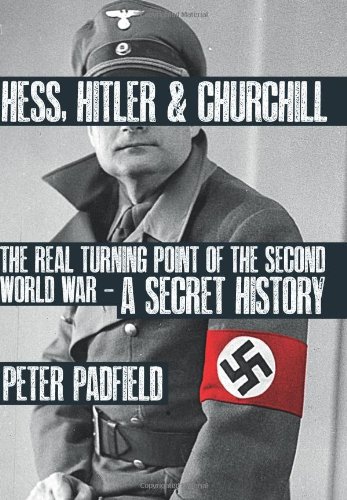
HESS, HITLER &
CHURCHILL:
The Real Turning Point
of the Second World War -
A Secret History
REVIEWS
Jon Stock, introducing an excerpt from the book in The Daily
Telegraph:
‘Peter Padfield reveals some startling new details about Rudolf Hess’s
secret peace mission to Britain in 1941. Hess, deputy Führer of
Nazi Germany, believed that a group of British aristocrats, bankers and royalty,
led by the Duke of Hamilton, were keen to remove Winston Churchill from office
and allow Germany to concentrate on the real enemy: Russia. But what was MI6’s
role in the affair? Why was Hess’s plane not shot down as it entered British
airspace? And how close did the British government come to making peace with
Adolf Hitler during the darkest days of the war?
In his recent five-star review of the book, Nigel Jones wrote: “This
grippingly readable book gives the fullest and most convincing exposition of one
of the 20th century’s strangest stories.”’
Nigel Jones, The Sunday Telegraph:
‘Padfield briskly and forensically dismisses the conspiracy theorists,
proving that the prisoner of Spandau was the real Hess, not a body double, and
that he took his own life and was not murdered.
However, Padfield is the first to admit that mysteries remain.
Successive governments have been unwilling to admit just how close Britain came
to making peace with Hitler during the darkest days of the war. Vital files on
Hess have been weeded or remain closed, and we are unlikely to know the full
truth. Until we do, this grippingly readable book gives the fullest and most
convincing exposition of one of the 20th century’s strangest stories.’
Dan Jones, ‘Books of the Year’, The Daily Telegraph
(Review):
...the author reconsiders the evidence for Rudolf Hess’s 1941 defection to
Scotland, and proposes a radically different course of events to that usually
supposed: one in which Hess travelled to Britain with Hitler’s backing, having
been encouraged to come by elements in the British secret services, and brought
the draft of a peace treaty. Padfield also debunks the myth that Hess was
murdered in Spandau prison during the eighties, establishing finally that he
hanged himself. It is a fascinating work of investigation.’